CELEBRATING THE BEST OF LOCAL — WASHINGTON, DC · MARYLAND · VIRGINIA
INQUIRE ABOUT MEMBERSHIP →

Nobody tells you
what to ask
She came to Hvar for her daughters. She stayed at the microphone to
talk about the other thing she does — catching babies in Idaho, and
what American women are never told about birth.
HOSTED BY ANNETTE SCHMITZ · JELSA, HVAR · 37 MIN

Haley Keely, CPM, LM, MSM — staff midwife at Treasure Valley Midwives, Boise.
LISTEN TO THE CONVERSATION
EPISODE FIVE OF FIVE · THE FIELD SCHOOL OF HVAR · 34 MINUTES
Haley Keely found the Field School of Hvar the way most people
find most things now. She was in Boise, thinking about what to do
when her elder daughter turns five, following homeschool accounts. The
algorithm did what algorithms do: homeschooling, then unschooling,
then — what about worldschooling? School somewhere else.
She did not believe it. She went through the school’s website looking for the
catch, the way you check a listing that is priced too low.
“I honestly thought it was too good to be true. I spent a lot
of time picking apart the website just being like — is this
real?”
HALEY KEELY
It was real, so she brought both girls: Willow, four and a half, and Esme, still
nursing. They run a Montessori programme at home, so the pedagogy was not a
leap. The rest of the argument was made by her partner, who is from South
Carolina and likes to remind her that Idaho is landlocked. She got the
educational structure she wanted. He got the sea. Fair trade.
THE TWO O’CLOCK SCHOOL DAY
The Field School runs its summer day from two in the afternoon until nine at
night, and every parent arrives sceptical of it. Haley did. So did we. It is the
single most disorienting thing about the place and, within about four days, the
thing everyone starts scheming about how to take home.
What it removes is the alarm clock — not the waking up, the consequence of
waking up. At home the alarm goes off and the checklist starts running
immediately: out the door, attendance, traffic, the four minutes that turn twenty
into forty. Here the morning is simply a morning.
The other end of the day matters just as much. Dinner, in her account, is a job
that should take twenty-five minutes and takes an hour, because she is stopping
to nurse, and Willow absolutely must show her the picture she has just drawn,
and needs help with her cape. On Hvar the cooking happens while the children
are at school. Her partner collects Willow at nine, and they sit down and eat and
hear about the day, with nobody being managed and nobody being a nuisance.
By the second week Haley was doing sums on the flight home in her head —
wondering whether a summer programme in Boise could run on these hours, and
whether American parents would be able to accept it.
Willow, for her part, has been coming home and running her own school: sit
down, everybody, cross your legs. She asks when she is going back. She wants to be
up in time for her nap so she is not late.
THE ARITHMETIC NOBODY EXPECTS
Would she come back? Almost certainly — and the reason is more prosaic than
the setting suggests. They already pay for school in Idaho. Set one bill against the
other and the Croatian summer is not, for them, a dramatically more expensive year.
“We could do school in Idaho, or we can do school here.”
HALEY KEELY
She is careful about this. For a family using the public system it is a whole new
line in the budget, and she knows it. But she also wants to coordinate with other
families and come back as a group — which is precisely the cohort Carolyn set
out to build, arriving on its own.
Jelsa, late afternoon. The conversation had been about school hours. It was about to be about something else.
THE OTHER THING SHE DOES
Somewhere in the second half of the conversation the subject turns, and it turns
out the parent we had been talking to about school hours delivers babies for a
living. She is a certified professional midwife in a group practice in the Pacific
Northwest — roughly sixty per cent birth centre, forty per cent home birth, two
birth suites upstairs and the clinic below.
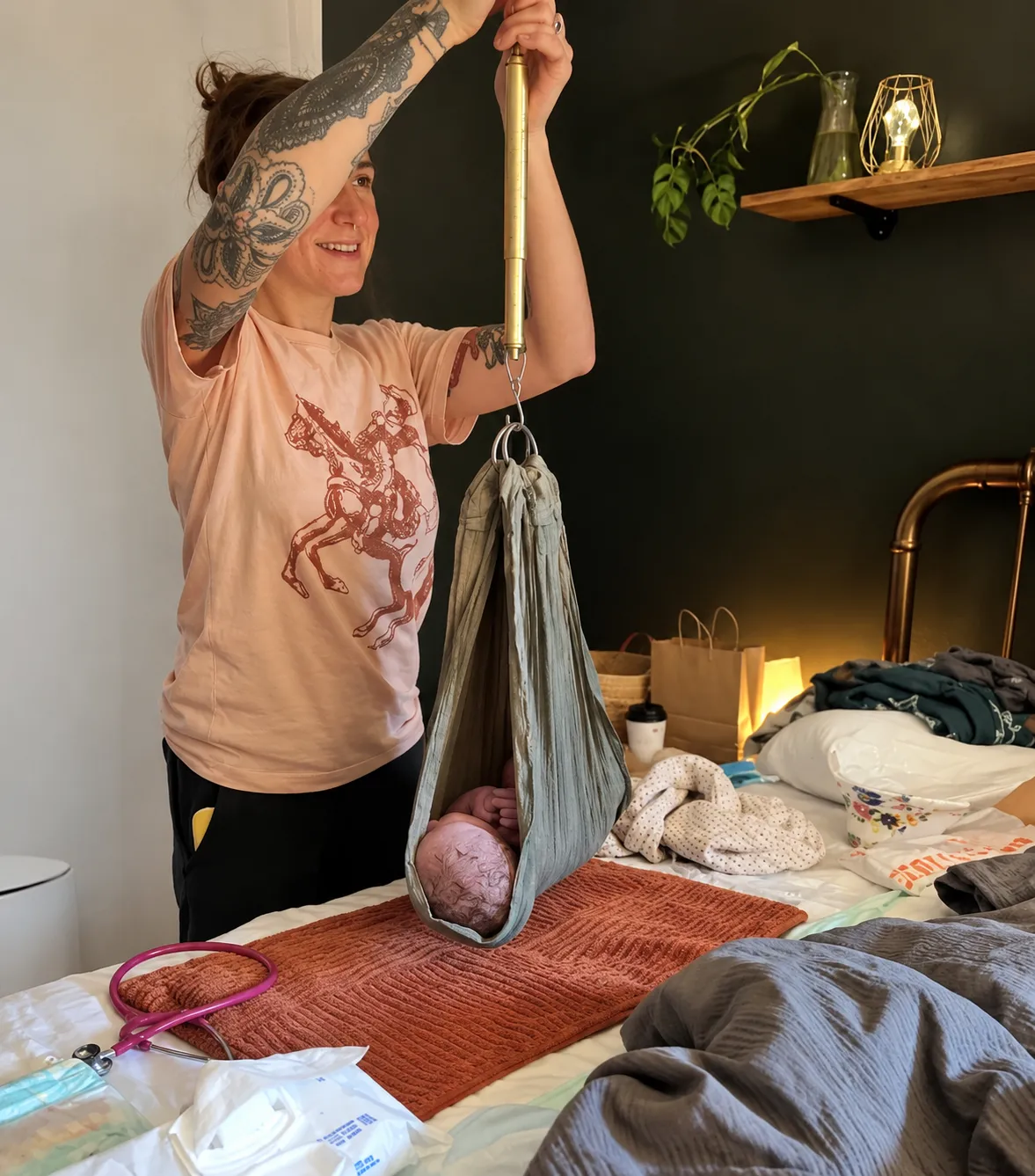
A newborn in the sling, minutes old. This is the other half of her week, and the half nobody at the school knew about.
She has been pointed at this since she was about ten. As a teenager she assumed
that meant becoming an obstetrician, because nobody had told her midwifery
existed. So at sixteen, newly able to drive herself, she started volunteering four-
hour Sunday shifts on the labour and delivery unit of a hospital in downtown
Flint, Michigan.
What she saw there ended the plan. Some of it was the ordinary carelessness that
tells you what an institution actually thinks of the people in it — a mother sent
home with the baby not buckled in and the car seat not fastened to the car. Some of
it was the absence of anything resembling support: a woman saying she would
not feed the baby, that was what the nurses were for, and nobody sitting down
beside her to ask why or to offer help. And running underneath it, she says, was
overt racism in a hospital serving a largely Black community, with no providers
she can remember who looked like their patients.
She was sixteen and could see it. She has spent the years since acquiring the
vocabulary for it.
“Why would I go to school for eight years for it to
culminate in this kind of care? That’s not what would be
true to my heart.”
HALEY KEELY
The money was the other half of it — eight years plus residency, and no one at
home to cover an apartment while she did it. So she went the opposite direction
entirely and enrolled in fashion school. It took a few years to come back around,
and when she finally learned that midwifery was a profession she could enter, the
argument was over. She took a master’s in midwifery at Bastyr, north of Seattle.
WHAT MIDWIFERY CARE ACTUALLY IS
Ask her the difference and she does not begin with birth. She begins with the
appointment. In the medical model a nurse practitioner does the measurements,
the doctor appears for five minutes and runs the checklist, and there is a decent
chance you will never see that doctor again — including at the birth. In her
model you spend the entire appointment with your midwife, who will be the
person at your birth, and who is using that hour to learn who you are.
Two things follow from that. The first is education: informed consent is not a
form you sign, it is the substance of the visit, and she is blunt that many hospital
conversations present a choice while being constructed so that only one answer is
available. The second is access.
“When you call, you don’t get a nurse who says your
provider will call you back in three to five business days.
You are connected directly to a midwife.”
HALEY KEELY
THE IRONMAN
The fear people bring to out-of-hospital birth is almost always about pain, and
she has a way of reframing it that is hard to shake. You will always meet the
woman — an aunt, a cousin, a stranger — who wants to tell a nine-months-
pregnant you that she could never have done it without an epidural, that she got
to the hospital and they would not give her one and it was the worst experience
of her life. Of course it was, Haley says. She had spent nine months preparing for
somebody else to take the pain away, and then somebody said no.
“It would be like somebody knocking on your door at five in
the morning saying, we’re going to go do an Ironman. And
you haven’t trained. You’d have a miserable time. Whereas if
you trained for nine months, and someone showed up with
donuts and balloons — you’d crush it.”
None of which is a claim that everyone should birth at home. She transfers
people, and says so plainly. The point is narrower and more useful: for most low-
risk, healthy people, out-of-hospital care is a real option, and the deciding
variable is not the setting but the provider. Vet them. Ask what their safety
protocols are. Ask what they do when a newborn comes out white and limp. Ask
whether they are trained in neonatal resuscitation and whether they carry anti-
haemorrhagic medication.
“I guess I should know this. And I’m like — why would
you? You don’t know to ask. But your provider does.”
HALEY KEELY
THE PART AFTER
Postpartum is where she thinks the American system quietly gives up. Her
practice sees you at home within twenty-four hours of the birth — you do not
pack a newborn into a car to be seen — then again at two, four and six weeks.
Every client leaves the six-week visit with a referral to a pelvic floor physical
therapist, whether or not anything is wrong.
“The best time to start pelvic floor physical therapy was
five years ago. The next best time is when you’re pregnant.”
HALEY KEELY
Her objection to the alternative is that women are told the consequences are
normal — that this is simply what having babies does — and then meet them
again at sixty as prolapse. “We don’t have to accept okay as our baseline,” she says.
The cost conversation is similar: more open than people expect. In her experience
most families with ordinary insurance pay somewhere in the region of eight to
ten thousand dollars out of pocket for a hospital birth, and most midwives
outside California charge less than that and will arrange a payment plan. What
you are buying with the difference is time, continuity, and the answers to the
questions you did not know to ask.
IF YOU ARE CURIOUS — WHERE SHE SAYS TO START
Book a consultation. Almost every midwife offers a free one, in person or by phone. Being curious costs nothing and commits you to nothing.
Have the hard conversation with your partner. If they are frightened, ask what they are frightened of, then go to the consultation together. Most of that fear is simply never having been told anything.
Hire a doula — especially for a first baby. Expect roughly $700 to $2,500 depending on where you live.
Put a midwife or doula fund on your registry. People are going to buy you something. It may as well be the birth you want. They will bring a onesie anyway.
Clean up your feed. Unfollow the perfect parents the day you find out. That is not real life, and you do not need it running in the background.
Find a midwife near you through the North American Registry of Midwives at narm.org, which now keeps a national directory.
Or ask her. Haley practices at Treasure Valley Midwives in Boise — twenty years serving Treasure Valley families, begun as a small home-birth practice and now the only accredited birth centre in Idaho, offering both birth centre and home birth. She says she is always happy to answer questions in her DMs: @haleyhasitall.
We asked because we were curious about a school. We are following this thread
because it turns out the story of a school and the story of a beginning are closer
than they look.
IN THIS CONVERSATION
THE SERIES · FIVE CONVERSATIONS
We were five families just an ocean. The Field School of Hvar is five conversations — the founder, her two teachers, and two of the families who came.
HOW WE DO THIS
Every County Edit feature works this way — the owner, the people
who make it, and the people who love it. If that’s your business,
let’s talk.
THE MONTHLY EDIT
The best of local,
in your inbox.
Once a month: one story, three businesses we’d send our own friends to, and our latest conversation.
One email a month. Unsubscribe anytime.