Away · The Inaugural Feature
What We Did
Last Summer
A small school on a Croatian island — and the standard for everything we publish next.
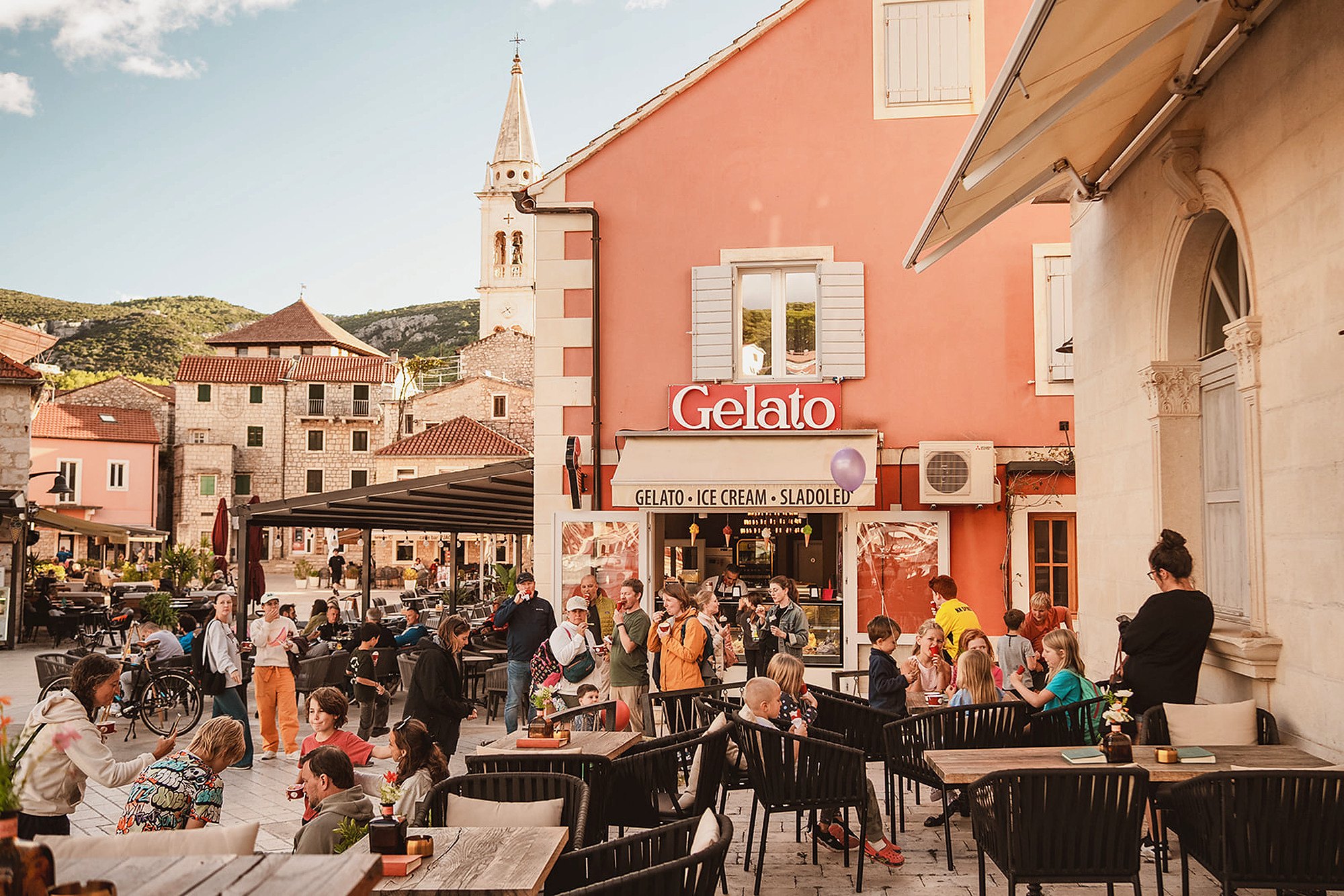
There is a particular light on the Adriatic in late August — low, unhurried, the color of the inside of a shell. It falls on stone streets and bougainvillea in the seaside town of Jelsa, on the island of Hvar, and on a school that does not look like a school at all.
There is no whiteboard. There are no worksheets, no projector, nothing digital in the room — there is frequently no room. The children are reading, and writing in journals, and learning the names of sea creatures, and crewing a wooden boat under full sail, and arguing, with evidence, about whether the afternoon should include gelato. In the mornings they are the first ones through the door.
We know this because we sent our own sons.
The Founder
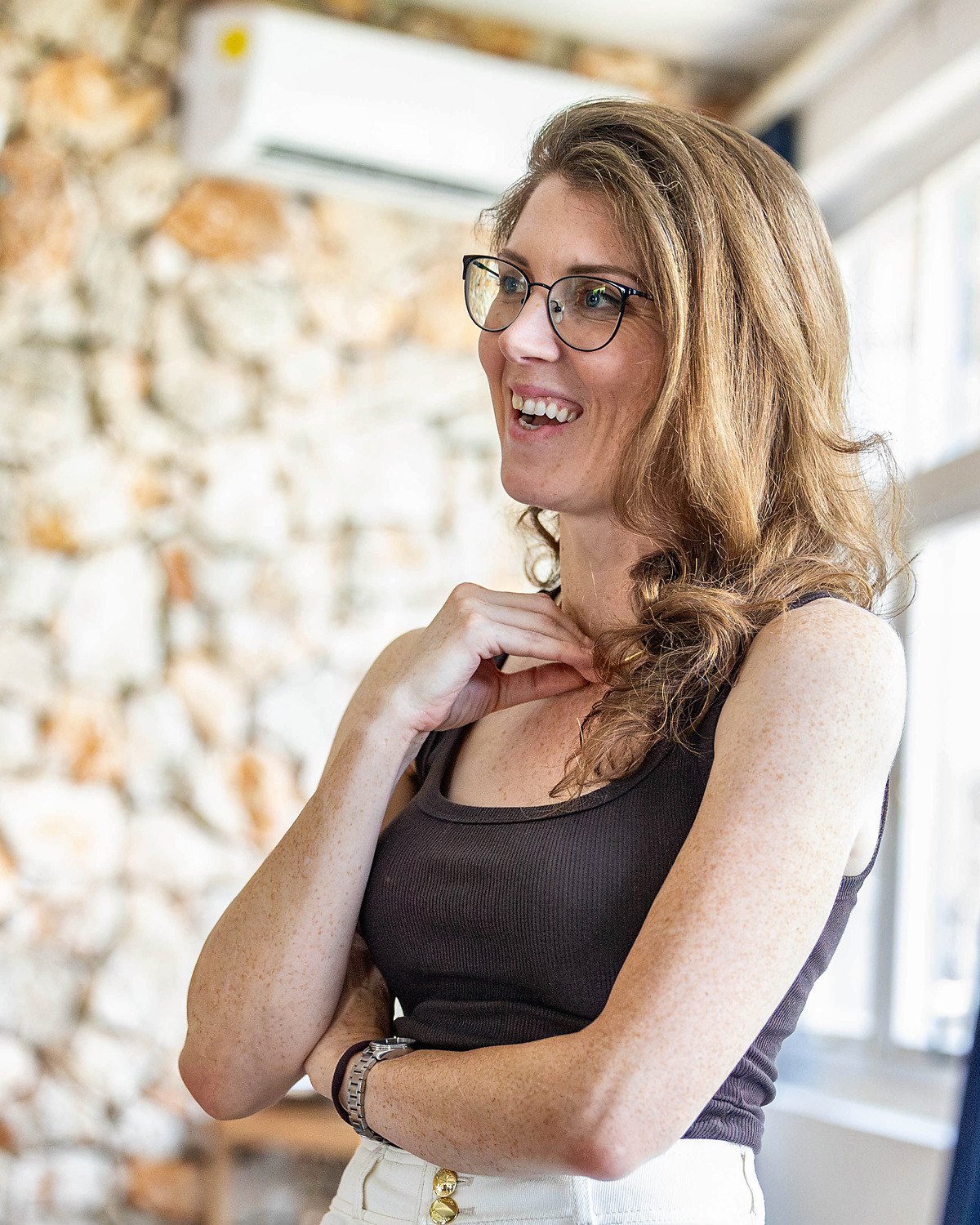
Carolyn Matijević is a Charlottesville native. She began in placemaking — she helped start a festival of culture and technology in her hometown — and then spent about three years at the Aspen Institute, living in Dupont Circle. From there: business school, and a stretch of work in climate finance.
Which is to say, before Hvar, she was one of us.
She did not move to a Croatian island to build a school. She moved, in her words, “through love,” and then looked around.
What she saw was a case for the work she had been doing all along. She had spent the pandemic years trying to manufacture something in the United States she could not find — launching a conference, learning to make sourdough, chasing a kind of community from scratch.
“I came here and I thought — it already exists. There’s already this authentic harmony between people and their landscape here that I’ve been searching for.”
Carolyn Matijević
The climate work gave the idea its shape. Tourism, she noticed, is generally either indifferent or actively opposed to the cultural and environmental health of the place it arrives in. So the most useful thing she could build was not a protest against tourism but a different version of it: a hub that gathers the people who already care, and gives the ones who don’t yet a reason to start.
It is a serious thesis, and she is disarming about how it came to her. “My mother teases me that my life is like the movie Mamma Mia,” she says. City girl, fast-paced, goes to a Mediterranean island, falls in love, never comes back.
What It Actually Is
The Field School of Hvar is a family slow-travel program, which is a phrase that undersells it. Three things run at once. Children get full-time drop-off enrichment that is nature-based, place-based and hands-on. Families get a walkable co-living village in a town small enough that nobody is driving anywhere. And the parents — this is the part nobody expects — get a real program of their own.
The school has three values, and Carolyn names them the way people name things they have had to defend: stewardship, enlightenment, dignity. Every project the children take on is tied to an impact goal. Regenerative agriculture. Low-carbon nautical tourism. Artisanal entrepreneurship. Low-waste, zero-kilometre schoolwear.
She has lived on Hvar for six years. Her son was born there; he is four now. He was two when the school began, and the school began, in part, because of him — quiet mornings wandering the olive groves together, and the thought that other families needed to experience this.
The First Year
She was standing in Vrisnik, a village near Jelsa, when she decided to stop considering it. She made a web page. She put it on Facebook. She reached out to a few people in the press — among them Kyle Chayka, the New Yorker writer, who still lives in the DC area and was an early public believer.
Then the families came. She lists them by name, unprompted, two years later: Lauren, Liberto, Victoria, Ivan and Katie, Evelina, Kelsey. Not only families — educators, too. Her background is not in education, and she knew from the start that the entire promise rested on finding people whose background was.
“It took a village to make a village.”
Carolyn Matijević
Year one was thirteen weeks of summer and, by any honest accounting, chaos. There was no classroom; they met in the park. There was no accommodation, so families found their own rooms around Jelsa. The schedule ran eight to twelve and four to eight — the good parts of the day, on paper — which meant the teachers had a twelve-hour day and a long, useless middle. “Which is insane,” she says now.
Year two added fall. Year three — this one — adds spring. There is a classroom now, at the Fontana, convenient and neighbourly. And there is a curriculum, built this year by Zoe Klute, the school’s academic dean and learning designer, which the faculty have made their own.
The Hardest Part
Ask her what nearly broke it and she does not reach for a logistics story. She talks about grace — learning that childcare buys you an unusual intimacy with families who all move through the world differently, and that their trust is a thing you have to learn how to hold.
And then she talks about being a mother while doing it.
“Whenever there’s pressure in a system, it is the most vulnerable people who end up bearing the burden of that pressure.”
Carolyn Matijević
In year one she could see it plainly: at twelve, sixteen, twenty-four hours in a day, there was not much left over for a two-year-old. “You can’t just say, the baking of the donuts can wait until tomorrow,” she says. “There is no tomorrow.” The guardrails she has built since are, to hear her tell it, the achievement she is proudest of.
The other lesson was about the teachers — that year one had been designed around what she knew a parent needs, and not around what an educator needs in order to be out in the heat for eight hours bringing an idea to life.
The Question Every Parent Asks
There is nothing digital in the classrooms. For a certain kind of parent — ours, frequently — that raises the obvious worry: how do I know my child is actually learning?
The answer is more rigorous than the setting suggests. The school runs Renaissance Star diagnostic assessments at the beginning and end of each term, watching for progression in literacy and math. The upper school programs are aligned to GCSE assessments — the British counterpart to roughly pre-AP, grades nine and ten — so older learners make progress toward their diplomas and transcripts while they are on the island.
She is not finished with the question, and says so. Assessment in project-based learning is genuinely hard: you can build a portfolio as vast as the experience itself and still miss the thing you meant to measure. There is a US-registered 501(c)(3), and a plan for a diploma-granting school in the States, to stitch the experiential work to the legible kind.
The Teachers
She is not doing it alone, and she is quick to say the teachers are the ones actually delivering the thing. Our sons spent the summer with two of them: Jordan Reese McClain and Artemisia Buonerba. Watch them for an afternoon and you notice what cannot be advertised: they are not performing patience. They have it.
On the first morning of camp, Jordan stopped her group at a donkey statue in town and told them, in about fifteen seconds, that donkeys are central to the history of Hvar — that sardines fed the people and the donkeys made everything else possible, the building, the travel. Days later, asked to work something of the island into their bag designs, one of our sons put a donkey in his, with a written note explaining why. She asked his permission, then showed the whole group what he had done and how far back he had reached to do it. The next morning he drew something quickly and handed it in; she told him she knew there were more thoughts in there than had made it onto the sheet, and asked for a few more details. He went back to it. It is the kind of detail no brochure would think to include, and exactly the kind we came for.
Artemisia Buonerba runs the excursions, which makes her the one who takes them off the island. Sailing one afternoon, she put a choice to her group: a second run under sail, or ice cream — except the ice cream was twenty minutes’ walk each way. Rather than decide, she taught them what an argument is. Something you say that might convince other people to vote for your proposal. You have five minutes, and nobody talks back while somebody else is making theirs. We can go tomorrow instead, with our parents. Good argument. But it will not be the same tomorrow, because it will not be here. Good argument. Then they voted, and swimming won three to two, and one of our sons lost a vote he had argued well. It is a very small thing that happens to contain critical thinking, persuasion, listening without interrupting, and the discipline of losing — and it happened over gelato.
We never feature just an owner. A place is never only the person who built it.
The Families
Ask the parents why they would send a child across an ocean for a summer and the answers rhyme.
Jelena and Alex had the money set aside to remodel their house. Jelena pointed out what they could do with it instead, and that was the first conversation in a chain that ended with the house rented out, both jobs resigned, and a year abroad of which two weeks were spent here. They found the school the same way Haley did — on Instagram, through an algorithm that had learned exactly what to show them — and Jelena’s family is from Serbia, which put the Adriatic within reach of people they wanted to see. What they describe from the fortnight is not the curriculum either. It is their daughter leading her own parents on a tour of Jelsa, and their son taking over in Stari Grad: not this alley, this alley’s no good, the next alley. “You can just tell he’s very proud that he knows something we don’t,” Alex says, “because for kids that’s a very rare thing.”
Haley Keely, a midwife from Boise, found the school on Instagram, decided it was too good to be true, and went through the website looking for the catch. She brought both daughters. What she talks about now is not the curriculum but the shape of the day. The summer school runs from two in the afternoon until nine at night — every parent arrives sceptical of it and nobody wants to give it up. There is no alarm clock, and so no checklist starting the moment it goes off. Dinner gets cooked while the children are at school, which means that when they come home you sit and eat it together and hear about the day, with nobody being managed and nobody being a nuisance. By her second week she was working out whether a summer programme in Idaho could run on the same hours.
We can vouch for the last part ourselves. The reliable measure of a summer, for a certain age of boy, is what you get when you ask how the day was. At home it is one line and a shrug. Here it was the Croatian song he had learned, and a full account of the sailing — how the boat had gone all the way over on one side and it was frightening, and how on the way back it was fine. To hear a child narrate his own nerve is not nothing.
The Parents Get a Program Too
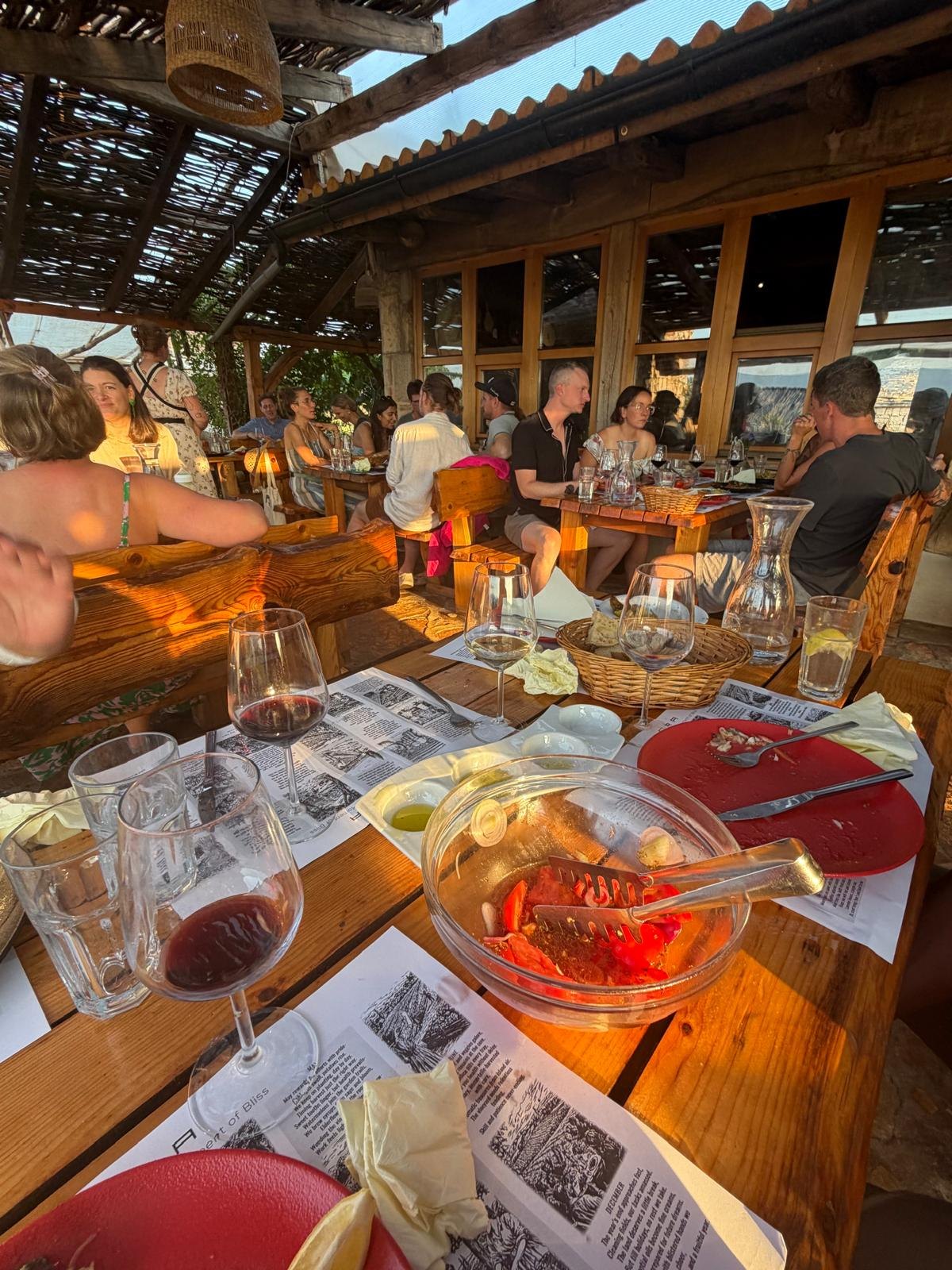
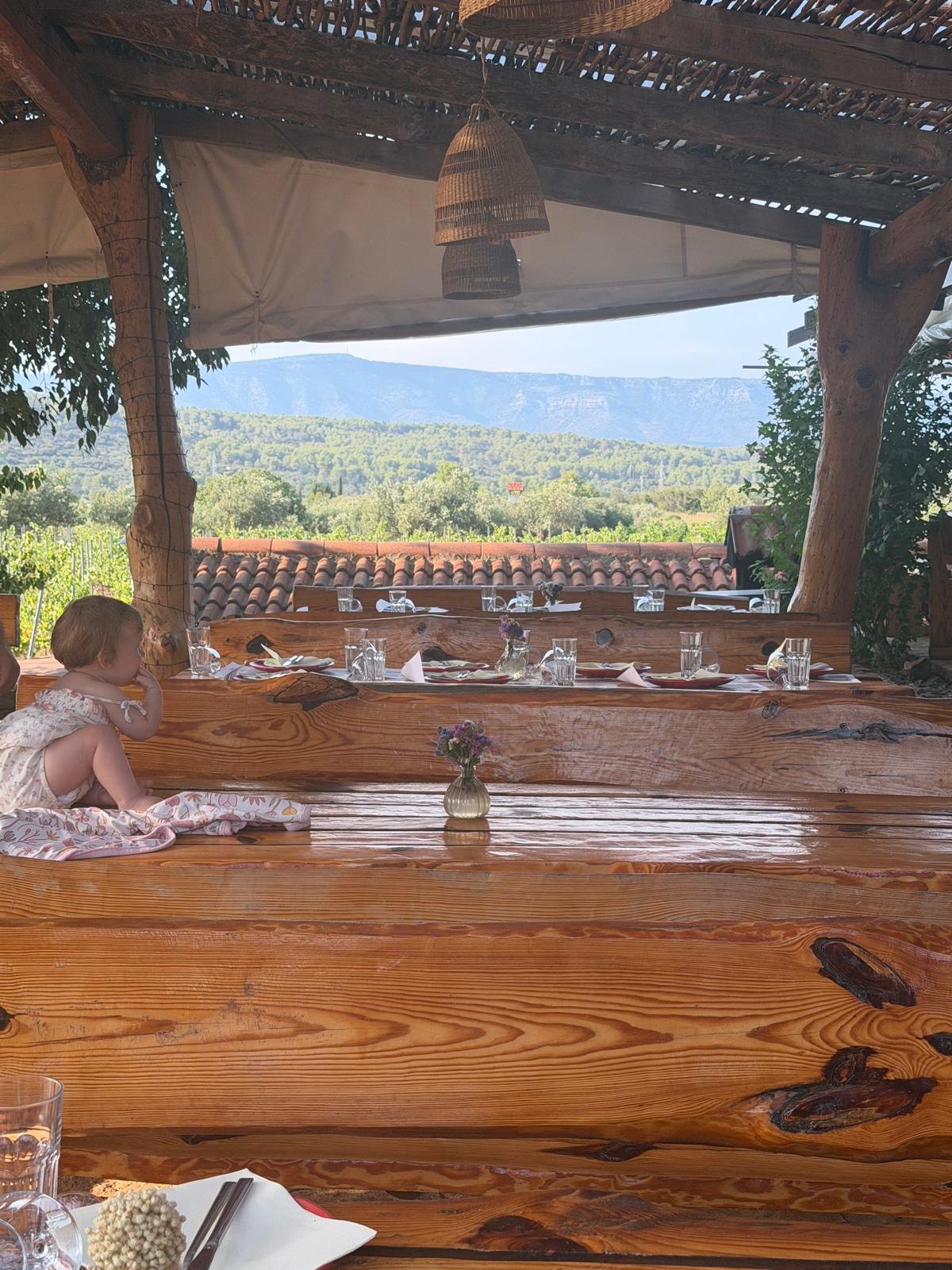
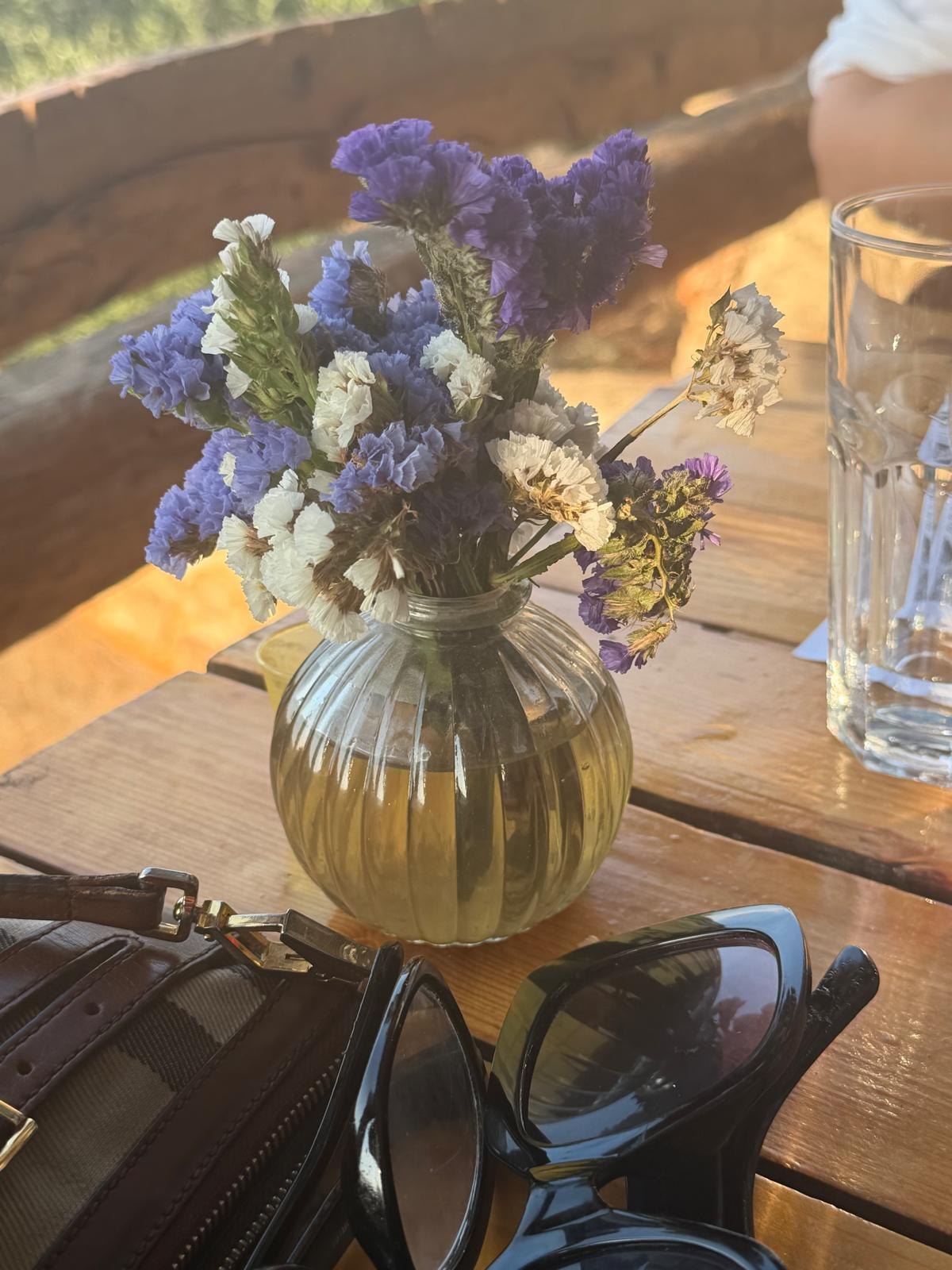
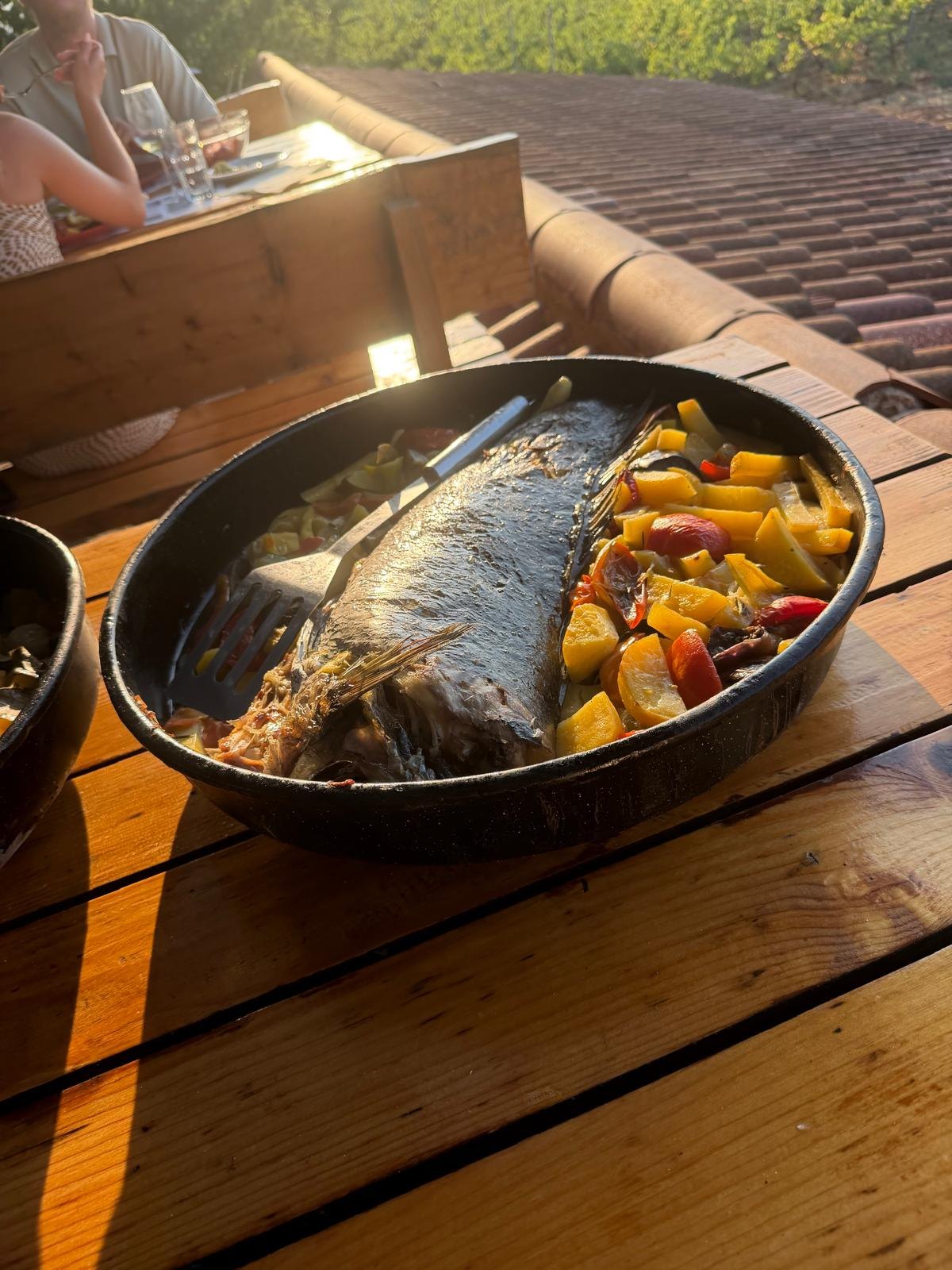
The tables under the reed roof, flowers, fish for dinner.
The welcome dinner exists because parents asked for it. The school runs a feedback session in every session, and what came back after the first dinner was: that was amazing, do more of that. So it became the first night — sunset, long table, strangers who will not be strangers by Wednesday.
Underneath it is a real idea about adults.
“One of them was to create a little bit of that freshman dorm experience for people in their prime years.”
Carolyn Matijević
We are, she points out, going through the most momentous decade of our lives — careers, children, aging parents, bodies — and are so compressed between competing demands that there is almost no time to process any of it alongside peers. The program does not solve that with a facilitated round table. It simply makes room: seven hours in which you are not actively managing another human being, and someone to spend them with.
The Croatia Most People Never See
Most people who know Croatia know Dubrovnik, Game of Thrones, perhaps Split, and Yacht Week. Sun, surf, dolce far niente. There is more, but you have to know where to look, because what is here is small families, individual artists and intellectuals quietly pursuing something in a little paradise.
“The island is about the size of Manhattan — you’re not going to just step out and see everything all at once.”
Carolyn Matijević
So the school takes families to a wine museum in a village nobody would think to drive to, and to the beaches that are not on any list, and the point lands: there is more here than you were told.
The Thread We’ll Follow Next
One of those parents is a midwife. She came to Hvar for her children and, the way the best conversations go, ended up telling us about her life’s other work — bringing babies into the world, and everything a family needs in the years that follow. We will pull that thread in a coming issue. It turns out the story of a school and the story of a beginning are closer than they look.
“I guess I should know this. And I’m like — why would you? You don’t know to ask. But your provider does.”
Haley Keely
Why This Story First
We are The County Edit, and we celebrate the best of local across the capital region. So here is a fair question: why is our very first story set on an island most of our readers will never visit?
Two reasons. The first is that it is genuinely ours — this is what we did last summer, and a publication that will ask you to trust its taste should start by showing you where it spends its own August.
The second is that it is the clearest way we know to show you what we are looking for. Not the biggest. Not the loudest. Not whoever paid the most. We are looking for Carolyn: someone who builds something with such care that strangers cross an ocean to be near it and go home changed. And for the people around her — the teachers, the families, the midwife — because a place is never just its owner.
Besides, it is closer than it looks. Charlottesville, Dupont Circle, and a school on the Adriatic. As Carolyn puts it: it has got DMV fingerprints all over it.
That kind of person is on your street, too. In the weeks ahead, we will introduce you.
The Series · Five Conversations
The whole story is a five-part podcast — a conversation with each of them: Carolyn, her two teachers, and two families.
Every County Edit feature works this way — the owner,
the people who make it, and the people who love it. If
that’s your business, let’s talk.