THE COUNTY EDIT CONVERSATION · THE FIELD SCHOOL OF HVAR
TWO OF FIVE · JORDAN REESE McCLAIN, TEACHER
The childhood
we all deserve
She left a fast-fashion job in Los Angeles, went back for a master’s,
and now teaches on a Croatian island — mostly outdoors, mostly by
the sea.
HOSTED BY ANNETTE SCHMITZ · JELSA, HVAR · 30 MIN
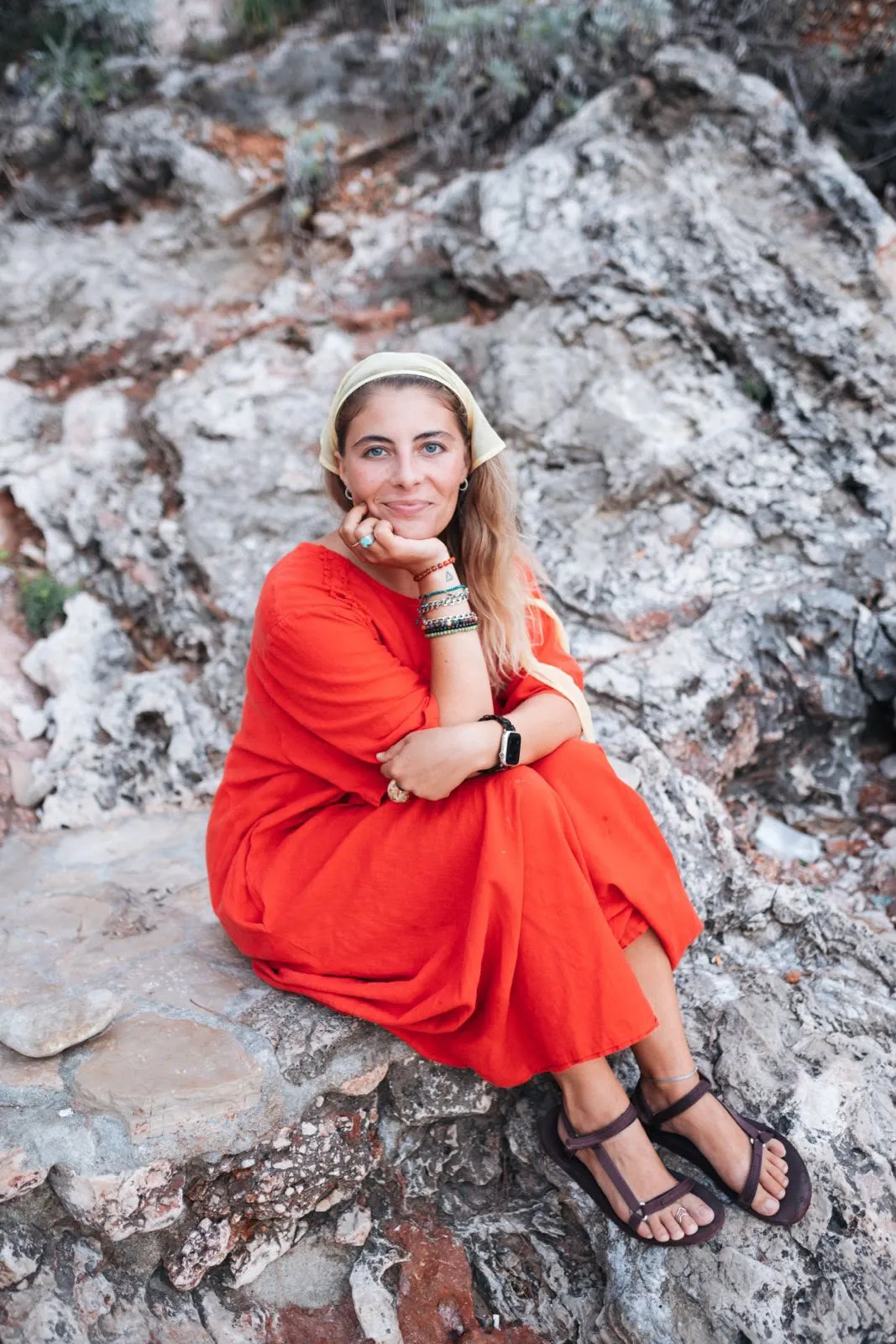
Jordan Reese McClain, above the water at Jelsa. She teaches here all year now.
FIND HER @jordanreesemcclain
The Field School of Hvar
LISTEN TO THE CONVERSATION
<iframe src="https://embed.acast.com/68f2653b9f00599e2da0efc9/6a9eda220797014d1e930853" frameBorder="0" width="100%" height="190px"></iframe>
EPISODE TWO OF FIVE · THE FIELD SCHOOL OF HVAR · 30 MINUTES
Two years ago Jordan Reese McClain went looking for a very specific job. She
wanted to teach outdoors. She wanted art at the centre of it, not
decorating the edges. She wanted to be somewhere regenerative
agriculture was something a community actually practised. And she
wanted to leave the United States.
She started the search in Croatia, because Croatia was already where her mind
went. Her mother’s family is Croatian. She had visited once with her parents and
had never felt so immediately at home — and for years afterwards, whenever she
was stressed, the place her head returned to was the sea on Hvar. So she typed the
question, essentially: does anything like this exist in Croatia? The Field School of
Hvar came back.
She applied for a short educator residency. Almost immediately she thought
better of it — she knew she would arrive and not want to leave — and asked to
teach full-time instead. That was last summer. She stayed through the fall. This
year she is on the island for all of it, and when we asked whether she would be
back next summer, the answer was two words. This is home.
Her route into teaching was not a straight line. USC, communications,
internships in fashion and art, then a job in fast fashion that lasted about as long
as it took her to understand what fast fashion is. She quit. She waited tables. She
had, by her own account, the classic early-twenties identity crisis. And then a
neighbour with three young children asked her to watch them for an afternoon,
and told her afterwards: no, Jordan — you’re really, really good at this.
She went back for a master’s in curriculum development, with a specialty in
culturally and linguistically diverse learners, because if she was going to do this
she wanted to know how to teach children who did not share her language or her
background. Then a Reggio Emilia-inspired preschool in Los Angeles, where she
discovered she could work outside and make art all day. That settled it.
“I can never go back to the indoors.”
JORDAN REESE McCLAIN
THERE IS NO NORMAL DAY
Ask her what a typical day looks like and she says there isn’t one; the three
constants are creating, making, and being outside. The morning we spoke, her
group was deep into building bags out of upcycled materials — first prototypes,
sewn by hand, then carried down to the beach and loaded with rocks to see
which seams held. Failure was the point. “For us it’s all about process,” she says.
“Expecting failures, regrouping from those failures, figuring out what’s next.”
The week before, she had handed each child fabric, thread and a needle and said
almost nothing. They were unsettled by it — I thought you were going to teach us
what to do — which is exactly what she was waiting to hear. She was collecting a
baseline. Every child, she says, arrives carrying funds of knowledge; some of them
can already do things she cannot. You find that out by sitting back,
not by talking first.
It is also how the assessment works. There is no worksheet to mark A correct, B
correct. She is watching how they collaborate, how they use a ruler, how they
map out a plan, how they write when they are labelling their own designs —
academic data gathered inside something the children actually care about,
because they are making a thing that has a reason behind it.
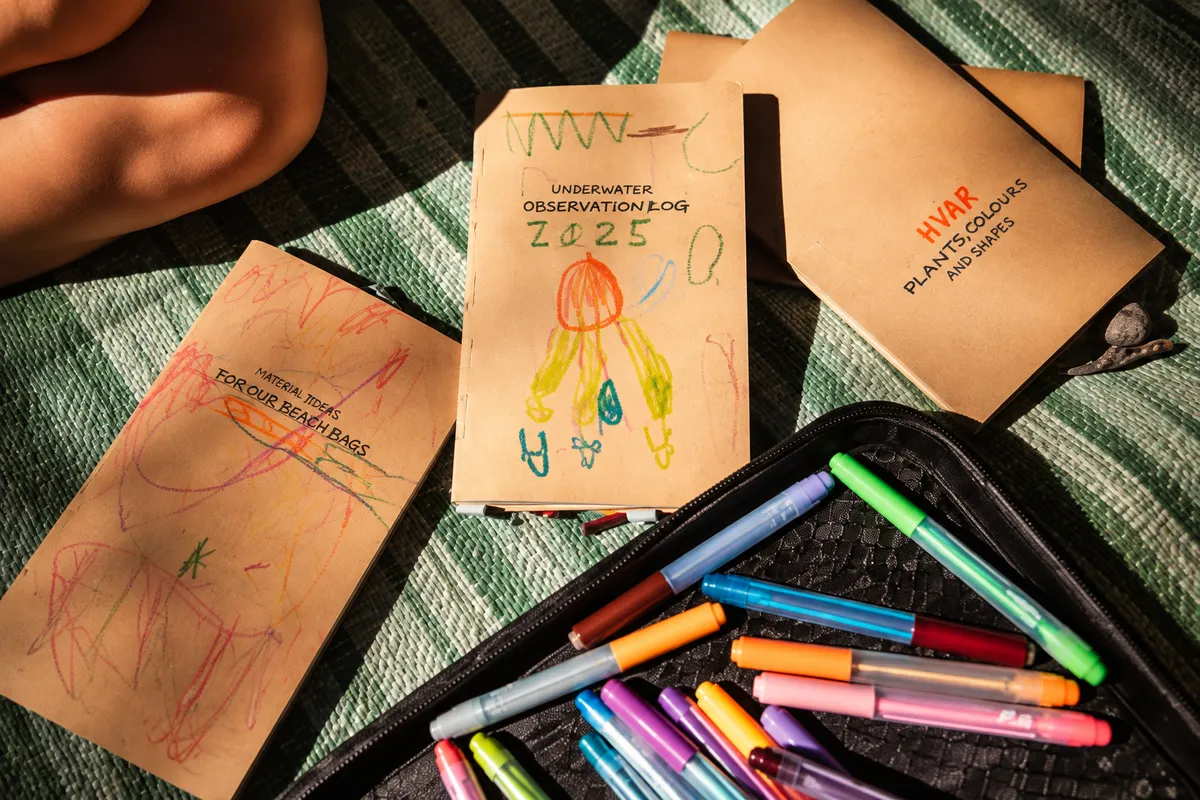
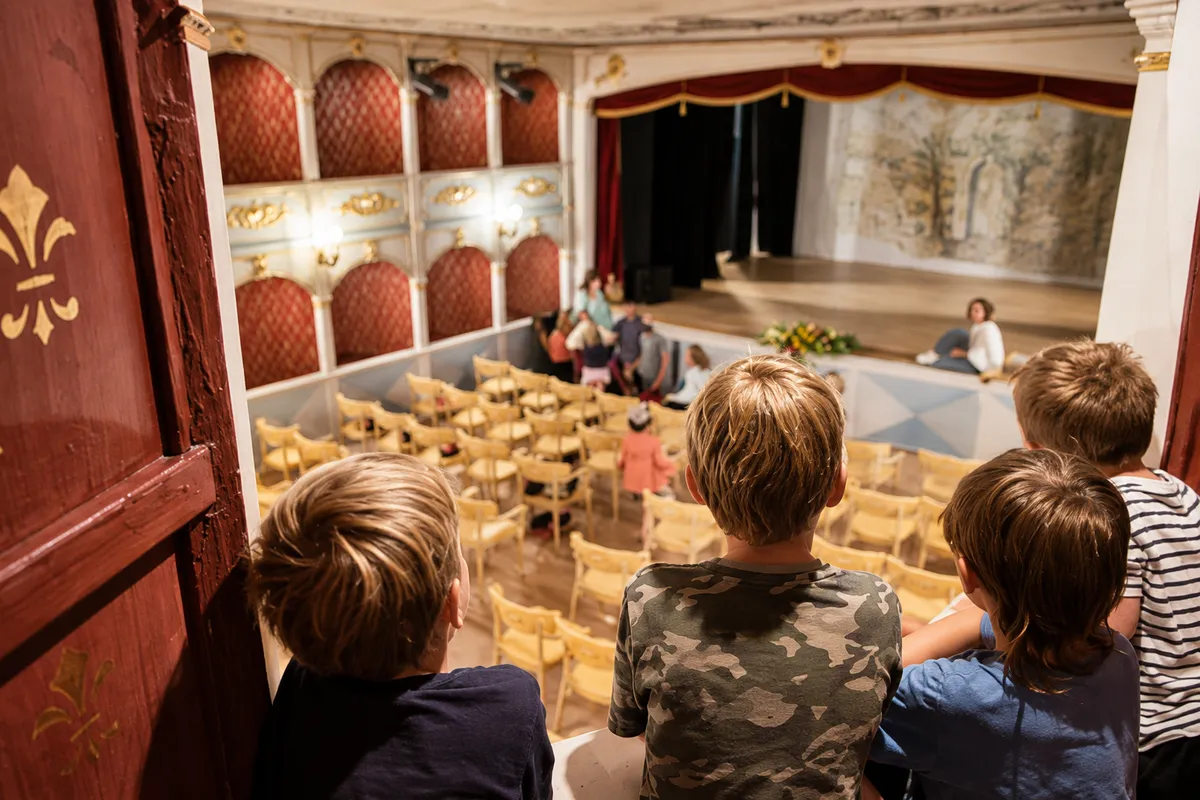
The classroom, most days: their own field notes, and an afternoon in the old theatre.
THE RULES ARE WRITTEN EVERY MORNING
It looks free-flowing. It is not unstructured. Each new group gets two days in
which Jordan mostly watches — who are we together, how much freedom can
this particular set of children hold — and then the boundaries get drawn with
them rather than for them. And they get redrawn daily, sometimes several times
a day, because the thing they are being kept safe from changes.
“There are very few things in this world that I know to be
true. One of them is that every time we come to the sea, it
will be different.”
JORDAN REESE McCLAIN
So they sit down at the water and name the risks in front of them that morning,
and agree the rules for that day. It gives them agency, and it makes them notice
— that ledge is slippery today — and they remember rules they wrote themselves.
When a group wanted to jump from a rock she judged too slick, she did not
simply say no. She explained where they were: on an island, with a clinic but not
a trauma centre, where something serious means a helicopter to the mainland.
They decided against it themselves.
“We are a field school. We are adventurers, we are
explorers. There is risk associated with that. But we do not
take unnecessary risks.”
JORDAN REESE McCLAIN
THE WARM DEMANDER
The phrase is one she picked up in graduate school and it is the closest thing she
has to a method. Lead with love. Celebrate the wins loudly and specifically. And
then hold the child to a higher standard, precisely because you have just shown
them you believe they can meet it.
Here is what that looked like on our sons’ first day. Walking into town, Jordan
stopped the group at a donkey statue and told them, in about fifteen seconds,
that donkeys are central to the history of Hvar — that sardines fed the people
and the donkeys made everything else possible, the building, the travel. Days
later, asked to work something of the island into their bag designs, one of our
sons put a donkey in his, with a written note explaining why. Jordan asked his
permission and then showed the whole group what he had done and how far
back he had reached to do it.
The next day he drew something quickly and handed it in. She told him she knew
there were more thoughts in there than had made it onto the sheet, and asked for
a few more details. He went back to it. Neither of us thinks he would have,
without the day before.
WHAT TWO WEEKS CHANGES
The summer sessions are short — two weeks, a new group each time. Asked what
she sees between the first day and the last, she names confidence first: children
trusted with a freedom they do not get at home, discovering they can handle it.
But the bigger shift is outward. They arrive focused on themselves. They leave
understanding that their ordinary actions have consequences and that being a
child is not a reason to wait.
“By the time they leave, they’re not just part of their
group, or part of the Field School community. They feel
like a part of the world.”
JORDAN REESE McCLAIN
Some of that, she thinks, is simply Croatia. Somebody explained the difference to
her once: in America children are met with expectations, and here they are
celebrated for being children — handed a lollipop at the bank for no reason
other than showing up. Children are allowed to be children here, and it changes
what a summer can do.
Asked what makes the Field School work, she gives three answers. Carolyn’s
vision, and the bravery it took to start something from nothing. The island itself.
And, above all, the other teachers — the reason, she says, that a programme
which resets every fortnight does not run out of energy.
JORDAN REESE
“Like energy attracts like energy. That’s the only plausible
explanation for how the most amazing teachers ended up
here.”
IN THIS CONVERSATION
00:29
Wanting out — and knowing exactly what she wanted instead
01:23
Croatian on her mother’s side, and the sea she kept returning to
02:18
“This is home”
02:48
Why there is no normal day
03:17
The bag project: prototypes, rocks, and planned failure
04:13
The question every skeptical parent asks
05:07
Handing a child a needle and saying nothing
07:19
Trigonometry, but you are building a boat
09:35
Fast fashion, waitressing, and the neighbour who told her the truth
12:26
Reggio Emilia in Los Angeles — “I can never go back to the indoors”
14:13
What changes in two weeks
15:57
Writing the rules at the sea, every morning
19:21
Fall and spring: an empty beach and six children
23:35
The warm demander
27:40
What makes the Field School work
← PREVIOUS
One · Carolyn Matijević
The founder. Before Hvar, she was one of us.
NEXT →
Three · Artemisia Buonerba
Teacher. You cannot get lost in a classroom.
IN THE INDEX
The Field School of Hvar
Jelsa, Hvar, Croatia · Family & Kids · Away
THE SERIES · FIVE CONVERSATIONS
We never feature just an owner. The Field School of Hvar is five conversations
— the founder, her two teachers, and two of the families who came.
01
Carolyn Matijević — the founder
Before Hvar, she was one of us ·
26 min
02
Jordan Reese McClain — teacher
The childhood we all deserve
30 min
03
Artemisia Buonerba — teacher
You cannot get lost in a classroom
35 min
04
Jelena and Alex — parents
We were going to remodel the house
20 min
05
Haley Keely — parent and midwife
Nobody tells you what to ask